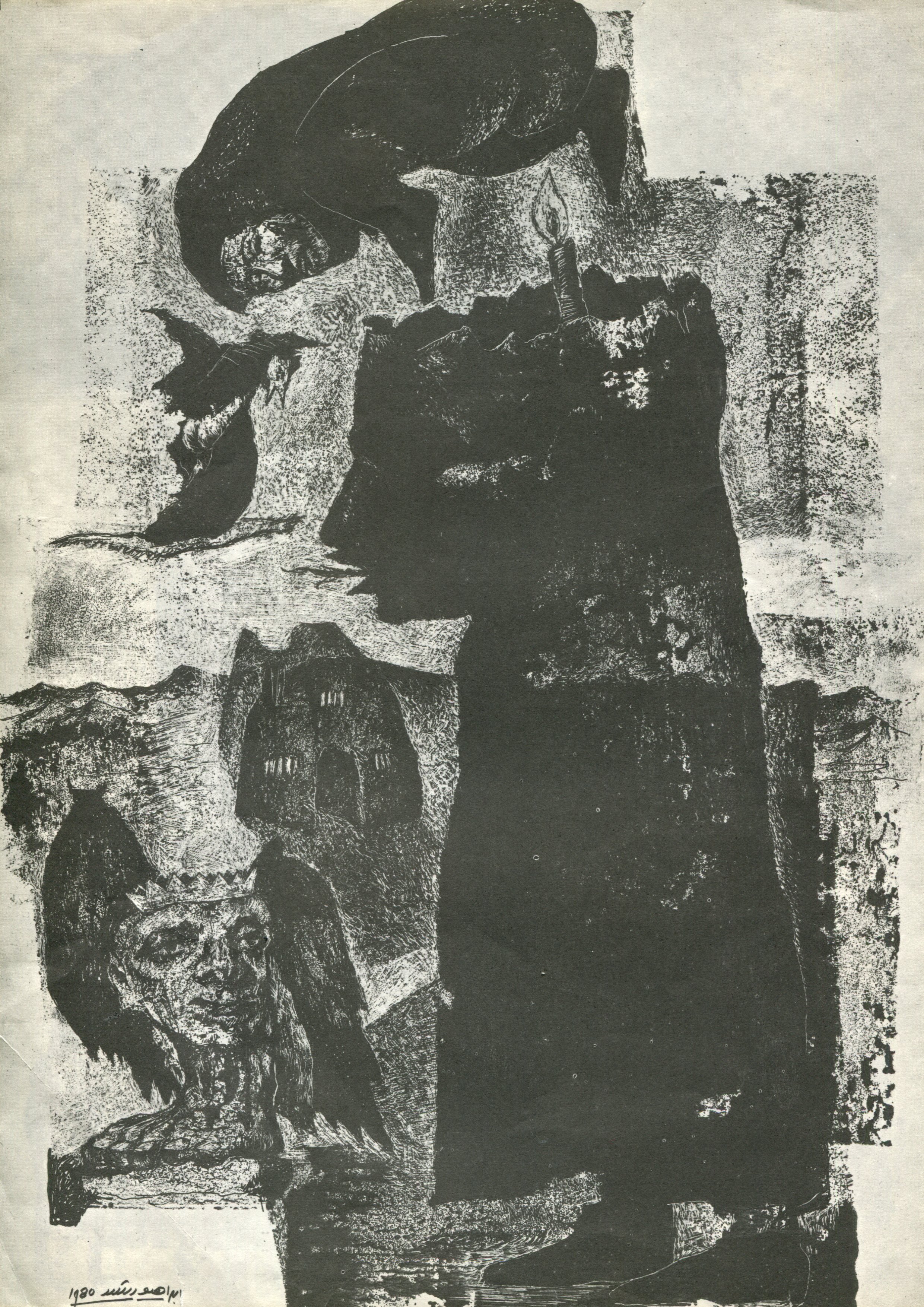
Prayer for the Absent
1983
Baghdad, Iraq
Charcoal on paper
22 x 28 cm
Ibrahim Rashid
—-
Ibrahim Rashid worked as an illustrator in Baghdad from 1975 into the 1980s,
first at Tariq al-Shaab (“People’s Path”) and later at Afaq Arabiya.
At Tariq al-Shaab, a left-wing newspaper and one of the few platforms
where poets, artists, and thinkers outside the ruling party could publish,
Rashid developed an understanding of illustration as more than an accompaniment to text.
Under increasing political censorship, the image became a way of communicating what could no longer be said openly
— a coded language for those who could read between the lines.
Four years after Rashid joined the paper, Tariq al-Shaab was banned amid a months-long purge
in which members of its staff and affiliated intellectual circles were imprisoned, executed, or driven into exile.
Rashid subsequently worked at Afaq Arabiya, a Baghdad literary magazine operating within the state cultural apparatus
during the increasingly violent and uncertain 1980s.
As censorship tightened, the need to speak indirectly became increasingly embedded in the visual language of the period.
Metaphor, allegory, and symbolism allowed Rashid to communicate meanings that could not be stated directly.
Several of the poets Rashid worked alongside were later assassinated or forced into exile.
Rashid’s drawings emerged from this condition: images shaped by censorship,
carrying meanings beneath the surface that could remain visible when words could not.