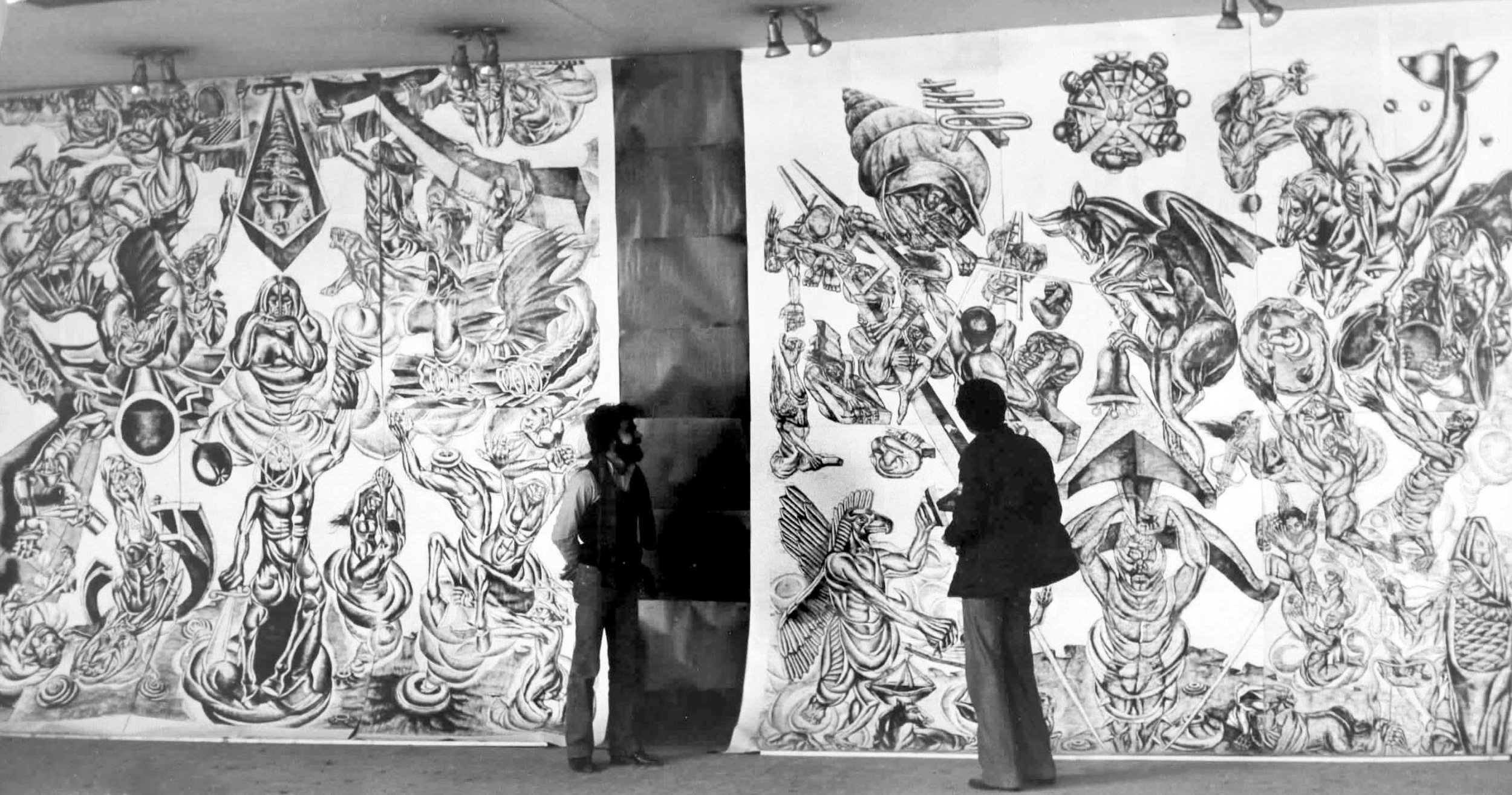
Ibrahim Rashid approaches painting through the human body, treating it as a site where memory, violence, censorship, and survival are materially registered. His figures are rarely presented as complete or stable forms. Eyes, limbs, organs, animal features, and mechanical elements are recombined into bodies that carry the traces of historical rupture and forced adaptation. Rashid has described this process as an “anatomy of memory.”
His visual language was shaped by his work as an illustrator in Baghdad from 1975 into the 1980s, first at Tariq al-Shaab (طريق الشعب, “People’s Path”), a left-wing newspaper, and later at Afaq Arabiya (آفاق عربية, “Arab Horizons”), a literary and cultural magazine. Tariq al-Shaab was banned during the tightening of state control over political and cultural life, after which Rashid continued his work within the literary press at Afaq Arabiya. Under strict censorship, drawing became a coded form of political and social commentary. Inverted figures, hybrid bodies, compressed anatomy, and dense hatching allowed meaning to circulate indirectly while retaining satirical precision and social engagement. This early press work formed a central vocabulary for his later painting.
In Rashid’s work, fragmentation operates as both a formal method and a historical condition. The body becomes a structure through which loss, displacement, substitution, and endurance are held together. Its absurdity lies in the logic of survival itself: incompatible parts coexist within a single figure, without resolving into harmony. Small drawings made in the trenches during the Gulf War later developed into I Am Not a Heroic Fish (2024), a large-scale paper series on the body under conflict. Unknown Epic (1980), his eight-metre woodcut panorama, stages mythological bodies within scenes of judgment and ritual. Removed by Iraqi authorities within a day of its exhibition, it received the Iraqi Critics Award five years later.
His recent series Big Bang (2020) extends this language through dense compositions in which human, animal, and mechanical fragments merge and no intact figure remains. Resistance to Erasure (2026), spanning painting, drawing, collage, and woodcut, continues his engagement with memory, power, and justice.
Born in Baghdad in 1957, Rashid graduated from the Academy of Fine Arts, Baghdad, in 1984. He migrated to Sweden in 1991 and later moved to Canada. He lives and works between Sweden and Canada.
Mori Art Museum — Tokyo, Japan
Darat al Funun — Amman, Jordan
MAI (Montréal, arts interculturels) — Montréal, Canada
Art Gallery of Burlington — Burlington, Canada
ASpace Gallery — Toronto, Canada
YYZ Artists' Outlet — Toronto, Canada
2 of 2 Gallery — Toronto, Canada
Kitchener-Waterloo Art Gallery (KW|ag) — Kitchener, Canada
Malmö Art Museum — Malmö, Sweden
Ronneby Konsthall — Ronneby, Sweden
Passagen Konsthall — Linköping, Sweden
Södertälje Konsthall — Södertälje, Sweden
Växjö Konsthall — Växjö, Sweden
Lund Konsthall — Malmö, Sweden
Trollhättan Konsthall — Trollhättan, Sweden
Landskrona Konsthall — Landskrona, Sweden
Kiruna Art Museum — Kiruna, Sweden
Vänermuseet — Lidköping, Sweden
Skånes Konstförening — Malmö, Sweden
Form/Design Center — Malmö, Sweden
Gallery Svalunda — Malmö, Sweden
Stafanstorps Konsthall — Stafanstorp, Sweden
Valisken Konsthall — Simrishamn, Sweden
Barbacka Konsthall — Kristianstad, Sweden
Skovhuset Konsthall — Vaerlose, Denmark
Møstings Hus — Copenhagen, Denmark
Farum Konsthall — Farum, Denmark
Gallery 2112 — Copenhagen, Denmark
Brunei Gallery — London, UK
Kufa Gallery — London, UK
Faulconer Gallery — Iowa, USA
Hotbath Gallery — Iowa, USA
Grinell Gallery — Iowa, USA
The Arthur & Mata Jaffe Center / Book Arts Project — Florida/Texas, USA
University of North Texas Art Gallery — Texas, USA
Arteast, The NewSpace — New York, USA
Contemporary Art Center — Baghdad, Iraq
Baghdad Art Gallery — Baghdad, Iraq
Alia Art Gallery — Amman, Jordan
British Art Council Gallery — Amman, Jordan
Turning Torso — Malmö, Sweden
City of Kiruna Hospital — Kiruna, Sweden
Lomma Library — Lomma, Sweden
General Hospital — Malmö, Sweden
Municipality of Malmö — Malmö, Sweden
Eriksberg (mural commission) — Sweden
City of Burlington (public art bench) — Burlington, Canada